
Your First Year with PlanAI: A 12-Month Product Roadmap
From market validation to financial modeling to go-live integrations—discover how PlanAI's feature set maps to every critical milestone in your startup's first year. Each phase of the journey unlocks different tools at exactly the right time.
The first twelve months of a startup follow a predictable arc. You validate a market opportunity, define your strategic positioning, build financial models, and establish operational systems. But most founders use the wrong tools at the wrong time—market research subscriptions they don't need until month 3, financial modeling tools before they have revenue assumptions, project management software when the team is still just two co-founders.
PlanAI's annual subscription is designed around this twelve-month startup journey. Every feature is purpose-built for a specific phase—from your first hypothesis to your go-live QuickBooks integration. Here's how to use the platform as your startup evolves.
The 12-Month Product Framework
Market Validation Phase
Market research scanner + Business model canvas refinement
Strategic Definition Phase
Strategy frameworks + Pitch deck development + Strategic lever evolution
Financial Planning Phase
Collaborative financial modeling + QuickBooks integration at go-live
Team Collaboration Phase
PMO tools: Notes, files, knowledge hub, to-do lists
Months 0-3: Market Validation Tools
Before you write code or hire employees, you need to validate that your idea solves a real problem in a real market. This is where founders should spend the first 90 days—and where PlanAI's market research and business model validation tools become essential.
Market Research & Scanner Tool
The market research scanner aggregates industry reports, competitor analysis, TAM/SAM/SOM calculations, and trend forecasts. Instead of spending weeks compiling data from scattered sources, use this tool to:
- Validate market size: Understand your total addressable market with confidence
- Map the competitive landscape: Identify existing players, pricing models, and positioning gaps
- Spot emerging trends: Find opportunities before markets saturate
- Define customer segments: Validate who actually needs your solution and why
Business Model Canvas Refinement
Your first business model canvas is a hypothesis. Over the first three months, iterate on the fundamentals:
- →Value proposition: What problem are you solving, and why does it matter?
- →Customer segments: Who are your early adopters vs. long-term customers?
- →Revenue streams: How will you monetize? Subscription? Freemium? Transaction fees?
- →Cost structure: What are your fixed vs. variable costs as you scale?
The business model canvas is collaborative—invite co-founders, advisors, or early customers to validate assumptions in real-time.
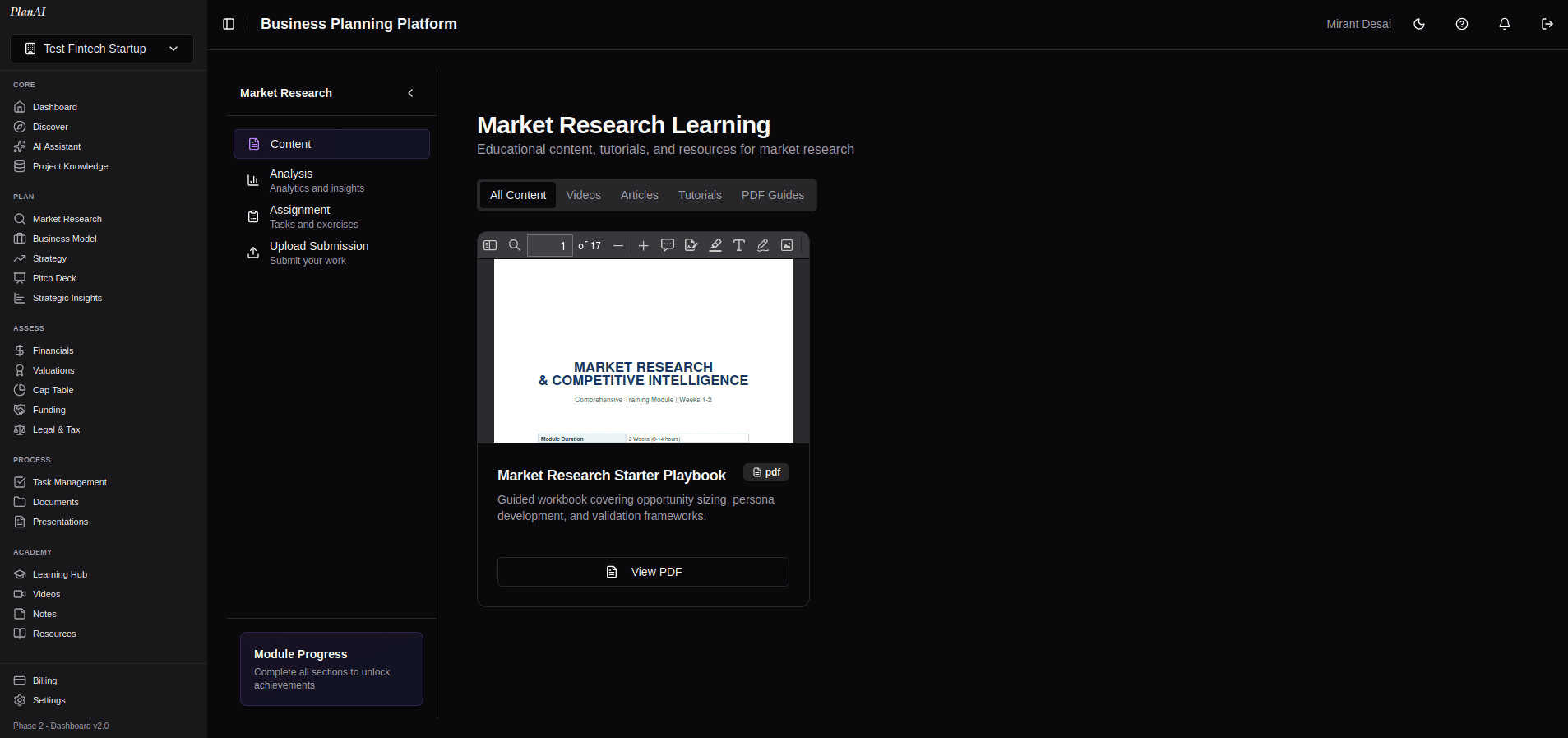
Market research module with trend analysis and competitor mapping
Months 1-6: Strategy Definition Tools
Once you've validated the market opportunity, it's time to build a strategic roadmap. This is where your pitch deck evolves from hypothesis to evidence—and where PlanAI's strategy frameworks guide your positioning.
Strategy Frameworks Module
PlanAI includes pre-built strategy frameworks from first principles—Porter's Five Forces, SWOT analysis, value chain mapping, competitive positioning, and more. These aren't static templates; they're interactive tools that adapt based on your industry and business model.
Use these frameworks to answer the hard questions: What's our moat? Who are our biggest threats? Where should we compete, and where should we avoid?
Pitch Deck Evolution: From Hypothesis to Reality
Your first pitch deck is aspirational. By month 6, it should be evidence-based. Track the evolution through PlanAI's pitch deck builder:
Month 1: The Hypothesis
Vision slides, market size assumptions, placeholder financials
Month 3: Early Validation
Customer interviews, MVP demos, early traction metrics
Month 6: Investor-Ready
Revenue data, unit economics, growth projections, competitive wins
Beyond: The Story
Narrative arc connecting vision to execution to scale
Strategic Levers: What to Pull, and When
Not every startup lever matters at every stage. PlanAI helps you prioritize which strategic levers to activate based on where you are in the journey:
- Q1:Product-market fit experiments, customer discovery, rapid prototyping
- Q2:Go-to-market strategy, channel testing, early sales playbook development
- Q3+:Scaling infrastructure, team hiring plans, operational efficiency optimization
Months 1-12: Financial Modeling & Integration Tools
Financial planning isn't a one-time exercise—it's a continuous process of forecasting, testing, and refining. PlanAI's financial modeling tools support branched collaboration, allowing your team to iterate on different scenarios without overwriting each other's work.
Collaborative Financial Modeling
Build multiple financial scenarios simultaneously. Your CFO creates a conservative forecast while your product lead models aggressive growth. Test break-even scenarios for investors. With branched modeling:
- Create multiple branches: Test best-case, worst-case, and likely-case scenarios side-by-side
- Real-time collaboration: Co-founders and finance team members edit forecasts simultaneously
- Version control: Roll back to previous financial models without losing work
- Integrated assumptions: Change one input (e.g., CAC) and watch the entire P&L update automatically
QuickBooks Integration at Go-Live
When you launch (typically months 6-12), your financial model stops being theoretical—it becomes operational. PlanAI integrates directly with QuickBooks to:
- →Sync actuals vs. forecast: Compare projected revenue and expenses against reality
- →Automated variance reporting: Get alerts when you're tracking ahead or behind budget
- →Real-time dashboards: See cash runway, burn rate, and key financial metrics at a glance
- →Investor reporting: Generate board decks with up-to-date financials in minutes
This integration closes the loop: planning becomes execution, and execution informs the next planning cycle.
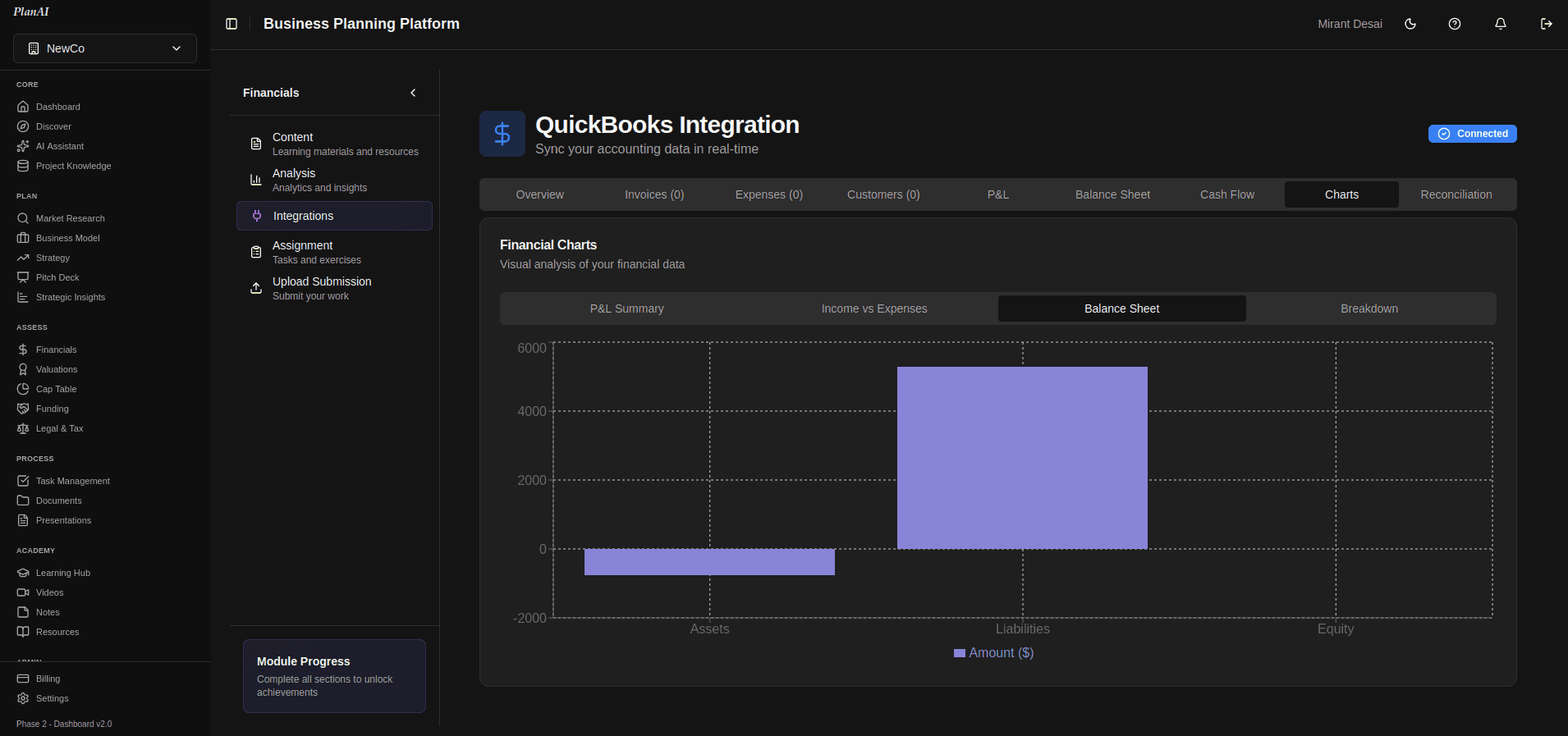
Financial modeling interface with collaborative editing and scenario planning
Ongoing: Team Collaboration & PMO Tools
Strategy and financials matter—but execution is everything. PlanAI's Project Management Office (PMO) tools keep your team aligned, organized, and focused throughout the entire twelve-month journey and beyond.
Notes & Documentation
Capture meeting notes, customer feedback, product specs, and strategic decisions in a centralized, searchable repository. Maintain context as your team grows.
File Storage
Store contracts, design assets, financial statements, and investor decks in one place. Version-controlled, access-managed, and integrated with your workflow.
Knowledge Hub
Build your startup's institutional knowledge. Document processes, onboarding guides, sales playbooks, and product roadmaps. New hires ramp up faster.
To-Do Lists & Task Management
Break down strategic goals into actionable tasks. Assign owners, set deadlines, and track progress. Ensure nothing falls through the cracks during rapid growth.
Why PMO Tools Matter in Year One
In the early days, communication is easy—you're three people in a garage. But by month 6, you've hired engineers, a marketer, maybe a sales rep. By month 12, you might be a team of 10-15.
Without structured collaboration tools, context gets lost. Decisions are forgotten. Tasks are duplicated. PlanAI's PMO suite ensures your team operates efficiently—even when you're moving fast.
Why an Annual Subscription Matches the Startup Timeline
PlanAI's annual plan isn't just about cost savings (though you save 20% compared to monthly billing). It's about committing to the full journey and having access to the right tools at the right time—from day zero to month twelve and beyond.
Annual Plan: $30/month, Billed Annually ($360/year)
Full platform access: Market research, strategy frameworks, financial modeling, PMO tools, and integrations
Unlimited team seats: Invite co-founders, advisors, and team members at no extra cost
QuickBooks integration: Sync actuals vs. forecast when you go live
Priority support: Direct access to our team for onboarding and guidance
14-day free trial: Test-drive the platform risk-free before committing
The Value of Integrated Planning
Consider what startups typically spend in their first year on disconnected tools:
- ❌Market research reports: $500-$5,000 per report
- ❌Financial modeling consultants: $2,000-$10,000 for a three-statement model
- ❌Pitch deck designers: $1,000-$5,000 for professional slides
- ❌Project management tools: $10-$20/user/month (adds up with team growth)
- ❌Accounting software integrations: $50-$100/month for advanced features
PlanAI gives you all of this—plus team collaboration—for $30/month.
Start Your 12-Month Journey Today
The first year of a startup requires different tools at different phases. You need market validation in month 1, strategic frameworks by month 3, financial modeling by month 6, and QuickBooks integration by month 12. PlanAI's annual plan gives you access to the complete product suite—so you have what you need, exactly when you need it.
Ready to Build Your Startup?
Get access to market research, strategy frameworks, financial modeling, and team collaboration tools—all in one platform. Start your 14-day free trial, no credit card required.
Questions about the annual plan? Reach out to discuss how PlanAI can support your specific startup journey—whether you're pre-revenue, fundraising, or scaling to profitability.
Related Product News
Discover: AI-Powered Business Intelligence Feed
Stay ahead of market trends with GPT-ranked news and strategic insights
Work Companion Integrations
Connect PlanAI with Google Sheets, Notion, and QuickBooks
Desktop App Launching April 2026
Native performance with offline access for Windows, macOS, and Linux