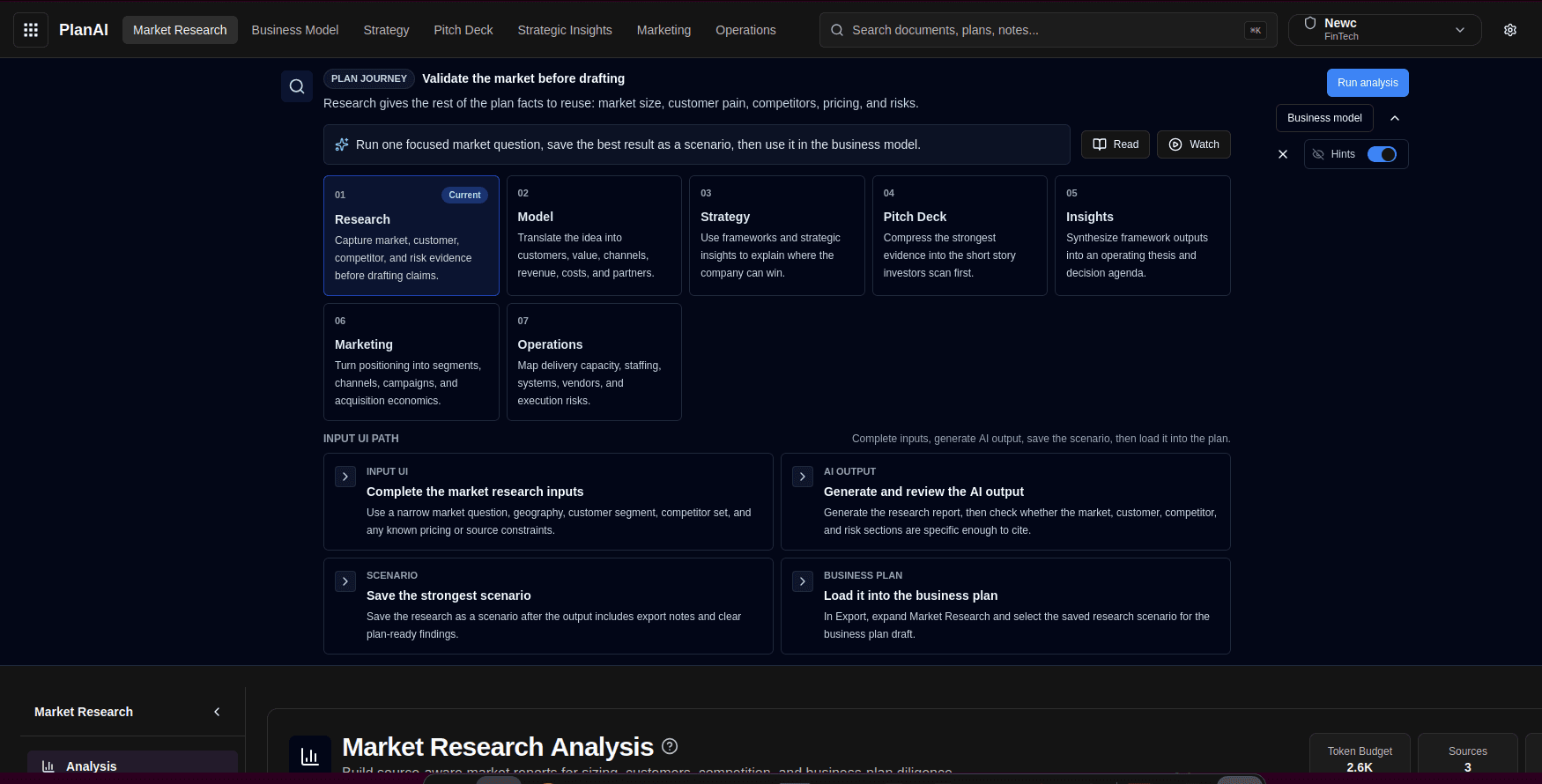
Contextual help gives users support that stays close to the module, artifact, and business decision they are working on.
The most useful help system is not a detached manual. It is a layer of guidance that understands where the user is, what the current task requires, and what kind of business reasoning is expected next. That is the role of contextual help in PlanAI. It turns support from a static reference into an active learning surface.
For a student, contextual help can explain why a market segment matters before they start sizing it. For a founder, it can clarify how an assumption affects pricing, hiring, or cash flow. For a team, it can make the structure of a plan easier to inspect, debate, and improve. The value comes from being close to the work rather than outside it.
Help that teaches while the user builds
Learning and business planning become stronger when explanation and execution stay connected. A concept can be introduced, explored, tested, and refined inside the same workspace where the user is building the plan. Contextual help reinforces that continuity by explaining the business idea at the moment it becomes useful and by keeping the next step close to the artifact being developed.
Learn the concept
Contextual help can explain the business idea behind the page the user is viewing, from market sizing and unit economics to operating model design.
Experiment with choices
Users can test assumptions, compare paths, and explore tradeoffs without leaving the business artifact they are trying to improve.
Structure the plan
The help layer connects learning and experimentation back to the sections, evidence, logic, and narrative needed in a stronger business plan.
Ask in context
Instead of starting from a blank prompt, users can ask questions from inside the active module, document, or planning workflow.
Experimentation becomes more disciplined
Experimentation is powerful only when the user can see what is being tested. In business planning, that usually means making assumptions explicit: who the customer is, what problem is urgent, how the product is priced, what costs scale with growth, and which milestones prove progress. Contextual help can keep those assumptions visible while the user explores alternatives.
From guessing to testing
A user can compare customer segments, revise a pricing assumption, change an operating model, or pressure-test a timeline while the help layer explains what changed and why it matters. The workflow becomes less about producing one answer and more about learning through structured iteration.
Better structure for better business plans
A strong business plan is not just a document with familiar headings. It is a connected argument. The problem should lead to the customer. The customer should lead to the market. The market should support the business model. The business model should connect to go-to-market, operations, financials, milestones, and risk. Contextual help reinforces those relationships as the plan develops.
Plan structure stays visible
Problem and customer
Market opportunity
Business model
Go-to-market
Operations
Financial logic
Milestones
Risks and assumptions
This is especially important in education and early-stage venture work, where the plan is also a thinking process. Users are not only trying to fill sections. They are trying to understand how choices fit together. Contextual help can point out missing evidence, weak links, unclear assumptions, and places where a stronger explanation would improve the plan.
A learning companion for the whole planning cycle
PlanAI's contextual help can support the full arc of work: reading a concept, applying it in a module, asking questions, revising an artifact, testing a scenario, and turning the outcome into part of a business plan. The experience is more useful because the guidance follows the user through the cycle instead of appearing only as a separate support page.
That design makes the workspace more forgiving without making the work less rigorous. Users can ask basic questions when they need orientation, deeper questions when they are testing a strategy, and structural questions when they are preparing the final plan. The help system becomes a way to keep learning, experimentation, and execution connected.
Contextual help makes PlanAI easier to learn and harder to misuse
The goal is not to hide complexity. The goal is to expose the right amount of structure at the right moment, so users can understand the business concept, test the decision, and build a plan that is clearer, more coherent, and easier to defend.
Explore PlanAI