Business Plan Agents as a Finished Product
PlanAI is moving business plan generation beyond one-off prompts. The finished plan is an aggregated agent output: strategy, market, finance, operations, and execution reasoning assembled into one usable business document.
A business plan should not feel like a pile of AI answers. It needs a point of view, a clear audience, internal consistency, and enough structure for a founder, lender, instructor, advisor, or investor to understand the business quickly.
PlanAI treats the business plan as the finished product of a coordinated agent workflow. Each agent contributes a focused piece of work, but the value comes from aggregation: turning those pieces into a single plan that reads like one document and reflects the full context of the business.
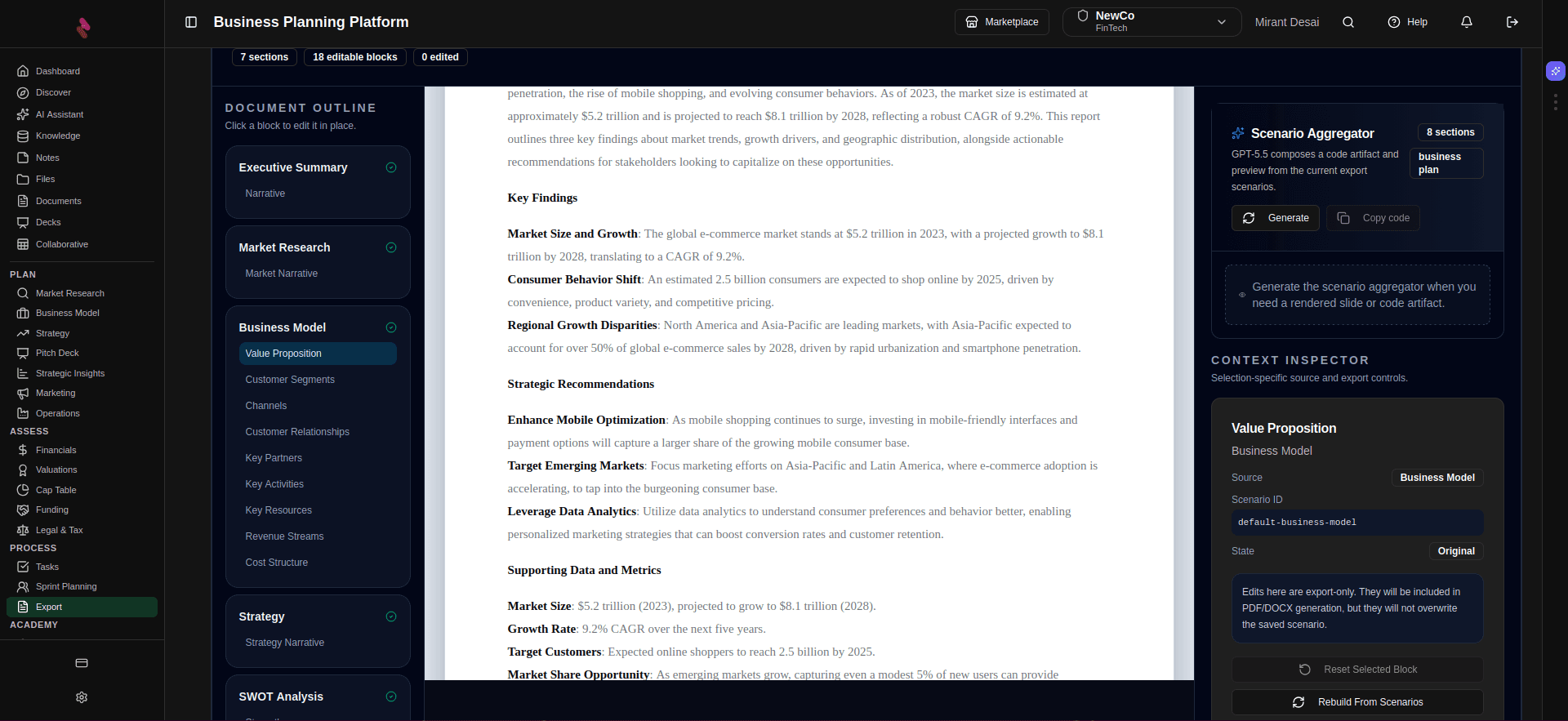
Agent work becomes useful when it is assembled into a coherent business plan artifact.
From Responses to a Finished Plan
Most AI planning tools stop at generation. They produce a section, a brainstorm, a table, or a draft. That is useful, but it still leaves the founder responsible for stitching everything together, checking for contradictions, and deciding whether the final document actually works.
Gather the business context
The system starts from project knowledge, founder notes, market research, strategic inputs, and financial assumptions already stored in the workspace.
Assign specialized agent work
Separate agents can reason through market positioning, customer segments, operations, financial logic, risk, milestones, and narrative structure.
Aggregate into one plan
PlanAI brings those outputs back together as a coherent business plan, resolving overlap and keeping the document focused on the audience.
Deliver a usable artifact
The finished product is a plan founders can review, refine, share, and use as a decision document instead of a temporary AI chat transcript.
Why Aggregation Matters
Business planning is cross-functional by nature. Market assumptions affect pricing. Pricing affects financial projections. Financial constraints affect milestones. Milestones affect hiring and operations. A finished plan has to hold those relationships together.
The artifact is the interface
Founders do not need a folder of detached outputs. They need a business plan they can read, challenge, edit, and present. PlanAI uses agents to create the underlying work, then aggregates that work into the document that actually drives the next decision.
What the Finished Product Should Do
- Explain the business: Present the customer, problem, solution, market, model, and execution path without forcing the reader to reconstruct the logic.
- Connect the sections: Keep strategy, positioning, financials, operations, and milestones aligned around the same assumptions.
- Surface tradeoffs: Make risks, constraints, dependencies, and open decisions visible instead of hiding them behind polished language.
- Support revision: Give founders a living output they can keep refining as the business learns from customers, capital, and execution.
A More Practical Form of Agentic Planning
The promise of agentic software is not just that many agents can run. The promise is that their work can become something useful. In PlanAI, that means a finished business plan: an artifact grounded in business context, shaped by specialized reasoning, and ready for human judgment.