Google and Gemini Integration
PlanAI already helps teams turn scattered inputs into structured business intelligence. Today, that experience gets sharper with deeper Google integration and the introduction of Gemini in our reasoning model stack. The result is a more connected workflow for founders, operators, and teams who want fast, reliable answers without leaving the systems they already use.
Built for the Google Ecosystem
Google tools are already central to how many teams plan, collaborate, and execute. PlanAI now fits more naturally into that workflow by making it easier to move analysis into the places where work happens: documents, spreadsheets, presentations, and shared team knowledge. Instead of treating AI output as a dead-end draft, teams can reuse PlanAI insights as active operating material.
Whether you are building a market brief, refining a financial model, or summarizing a strategy session, the Google integration keeps your outputs portable and practical. That means less reformatting, less manual copy-paste work, and a cleaner path from reasoning to execution.
Why Gemini Matters
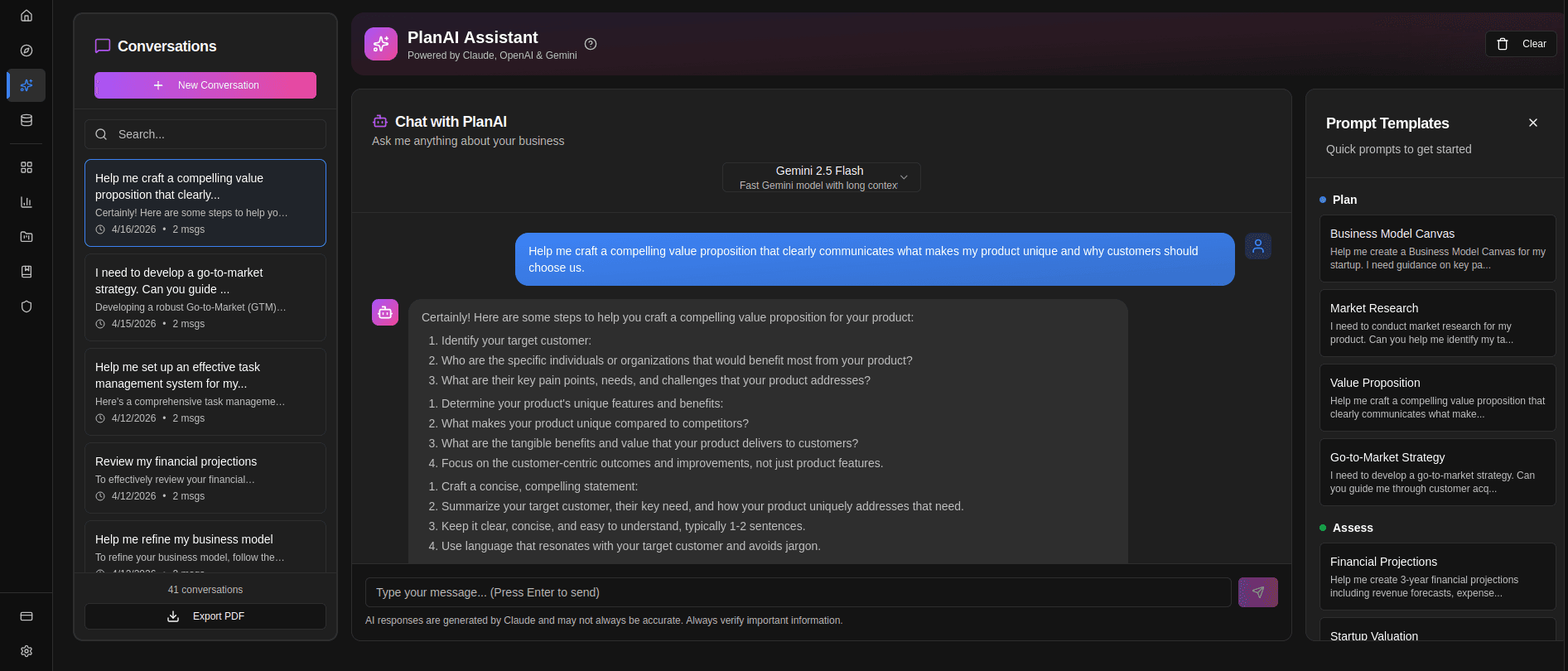
Gemini expands the range of reasoning capabilities available inside PlanAI. Different tasks call for different strengths, and Gemini adds another strong option for synthesis, analysis, and multi-step thinking. For users, that means more flexibility when working through business questions that require speed, context awareness, and structured output.
- Faster business reasoning: Get responses that help move from question to decision with less friction.
- More model choice: PlanAI can route work to the model best suited for the task at hand.
- Better workflow fit: Use Gemini alongside Google-native tools for a more unified operating experience.
- Stronger context handling: Keep complex business threads organized as you move between analysis and action.
One Platform, More Reasoning Options
PlanAI's approach has always been to combine the best tools into one practical business system. Adding Gemini reinforces that strategy. Rather than forcing teams into a single AI style, we give them a platform that can adapt to the task, the workflow, and the level of rigor needed for the job.
This matters most when work is iterative. A founder might use one model to explore opportunities, another to pressure-test assumptions, and Gemini to synthesize the final recommendation. The value is not just in having access to more AI. It is in having an environment where the right reasoning engine is available at the right moment.
A More Connected Planning Flow
With Google integration and Gemini together, PlanAI becomes a tighter bridge between AI reasoning and day-to-day execution. Teams can think in PlanAI, refine in Google Workspace, and keep momentum without losing structure or context.
What Users Can Expect
Strategy Teams
Move from research and reasoning into working docs and team reviews faster, with fewer handoffs between tools.
Founders and Operators
Use Gemini-powered reasoning for planning, then export the results into the Google tools your team already uses every day.
Cross-Functional Workflows
Keep business knowledge flowing across planning, collaboration, and delivery without losing the context that makes AI useful.
Moving Forward
PlanAI will continue expanding the model choices and integrations that make business reasoning more practical. The addition of Gemini is part of a larger goal: give teams a system that adapts to how they actually work, instead of making them adapt to the software.
If your team already lives in Google Workspace, this update makes PlanAI feel even more connected to your daily workflow. If you are evaluating AI tools for business planning, this is another sign that PlanAI is built to be a durable operating layer, not just a point solution.